Does Insurance Cover Weight Loss Medication?
Yes, some health insurance plans cover prescription weight loss medications, including Wegovy, Zepbound, Saxenda, and certain oral drugs. Others exclude weight management medications entirely. Coverage depends on your specific plan, the prescribed medication, your medical history, and whether you meet the insurer’s approval requirements.
Having insurance does not automatically mean your prescription will be covered. Even when a medication is on your plan’s drug list, you may need prior authorization, documented medical necessity, or proof of previous treatment attempts.
Here’s what determines coverage, which medications may qualify, and what to do if your insurer denies payment.
When Does Insurance Cover Weight Loss Medication?
Health insurance may cover prescription weight loss medications when your plan includes benefits for obesity or chronic weight management. Approval usually depends on the prescribed medication, your BMI, medical history, and whether prior authorization is required. However, even plans from the same insurance company can have different coverage rules, so checking your specific policy is essential.
When Insurance May Cover Weight Loss Medication
Your chances of approval depend on several factors:
- Your plan includes prescription medications for weight management.
- The prescribed drug is listed on the plan’s formulary.
- Your BMI and medical history meet the insurer’s eligibility rules.
- Your provider documents a qualifying diagnosis and treatment need.
- Required prior authorization is completed and approved.
- Any applicable step-therapy requirements are satisfied.
Many weight management medications are prescribed to eligible adults with a BMI of 30 or higher, or 27 or higher with a weight-related medical condition. Insurers may apply different criteria, including additional treatment requirements.
Why Insurance Plans Have Different Coverage Rules
Insurance companies offer different policies to employers, individuals, and government programs. One plan may cover medications for obesity while another plan from the same insurer excludes them.
Employer-sponsored plans can also differ because employers may decide whether to include certain weight management benefits.
The insurance company’s name alone cannot confirm your coverage. You need to check your specific plan’s pharmacy benefits, formulary, and exclusions.
How to Check Whether Your Insurance Covers Weight Loss Drugs
Start with your insurance card, member portal, or prescription drug benefits documents. Ask your insurer or pharmacy benefit manager:
- Does my plan cover prescription medications for chronic weight management?
- Is my prescribed medication on the formulary?
- Does it require prior authorization or step therapy?
- What are the BMI or medical eligibility requirements?
- What will I pay after my deductible, copay, or coinsurance?
Ask for the representative’s name or call reference number. If possible, request written confirmation of the coverage rules.
Remember that insurance coverage for a medical consultation is separate from prescription drug coverage. Your doctor may be in-network even when the prescribed medication is not covered.
If you need help discussing your treatment options with a provider, a telemedicine consultation can provide a convenient way to review your medical history and next steps.
What Weight Loss Drugs Are Covered by Insurance?
Several FDA-approved weight loss medications may be covered by health insurance. However, there is no universal list of medications that every plan must cover.
Some plans favor lower-cost oral medications. Others include GLP-1 medications but require additional documentation before approving them.
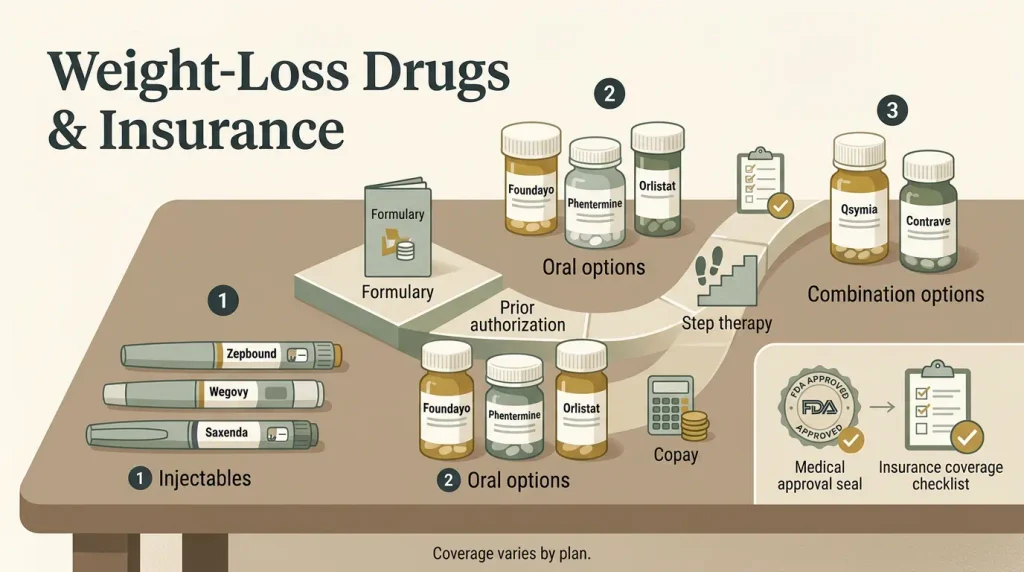
Weight Loss Medication Coverage Comparison
| Medication | Type | Insurance coverage considerations |
| Wegovy (semaglutide) | Injection or oral tablet | Coverage depends on the approved indication, formulary, and plan requirements. |
| Zepbound (tirzepatide) | Injection | May require prior authorization and documentation of BMI or related medical conditions. |
| Saxenda (liraglutide) | Daily injection | Coverage may require medical history, BMI records, and previous weight management attempts. |
| Foundayo (orforglipron) | Oral GLP-1 medication | Coverage varies as insurers update formularies for this newer medication. |
| Qsymia | Oral combination medication | Some plans cover it with restrictions or step therapy. |
| Contrave | Oral combination medication | Coverage depends on the formulary and individual eligibility. |
| Phentermine | Oral prescription medication | Generic versions may be less expensive, although coverage and treatment duration vary. |
| Orlistat | Oral medication | Prescription coverage varies; some formulations are available without a prescription. |
Medication availability, approved uses, and coverage rules should be verified with the prescribing clinician and insurance plan.
Are Oral Weight Loss Medications Covered by Insurance?
Some plans cover prescription weight loss pills, including phentermine, orlistat, Qsymia, and Contrave.
A lower-cost oral medication may be easier to obtain under certain formularies, but that does not mean it is appropriate for every patient. Medical history, other prescriptions, potential side effects, and treatment goals all matter.
Does FDA Approval Guarantee Insurance Coverage?
No. FDA approval determines whether a medication can be marketed for its approved uses. It does not require an insurance company to pay for it.
A drug can be medically appropriate and FDA-approved while still being excluded from a patient’s prescription benefits.
What Insurance Requires Before Approving Weight Loss Medication
Many insurers require prior authorization before paying for prescription weight management drugs. This allows the plan to review whether the treatment meets its specific coverage criteria.
Common Eligibility Requirements
Depending on the medication and plan, requirements may include:
- Current BMI and weight measurements
- A diagnosis of obesity or another qualifying condition
- Documentation of related conditions, such as hypertension or sleep apnea
- Previous weight management treatment attempts
- Participation in nutrition or lifestyle management
- Medical records supporting the prescribed treatment
- Previous medication trials, if step therapy applies
How Prior Authorization Works
Your prescribing provider submits clinical information to the insurer or pharmacy benefit manager.
The plan reviews the request and decides whether the medication meets its coverage policy. It may approve the prescription, request additional records, or issue a denial.
Approval may also expire. Some insurers require updated weight measurements, treatment progress, and confirmation that medication remains medically appropriate before renewing coverage.
Can Your Doctor Help Get Weight Loss Medication Covered?
Yes. Your healthcare provider can document your diagnosis, submit prior authorization forms, explain medical necessity, and respond to insurer requests for additional information.
However, a provider cannot guarantee insurance approval, especially when the plan explicitly excludes weight management drugs.
Does Insurance Cover Saxenda?
Some insurance plans cover Saxenda for chronic weight management, but approval often requires medical documentation and prior authorization. Coverage generally depends on:
- Whether your plan includes weight management medication benefits
- Whether Zepbound appears on the formulary
- Your BMI and qualifying medical conditions
- Previous treatment requirements
- Approval of the prior authorization request
Zepbound also has an FDA-approved indication for moderate to severe obstructive sleep apnea in adults with obesity. Insurance requirements for that indication may differ from those for weight management alone.
What if Zepbound Is Not Covered?
Ask your insurer why the prescription was denied. Depending on the reason, your provider may:
- Submit missing clinical documentation
- Request a formulary exception
- Appeal the coverage decision
- Recommend a covered alternative
- Discuss self-pay or eligible manufacturer savings options
An explicit policy exclusion may be more difficult to overcome than incomplete prior authorization.
Are Weight Loss Shots Covered by Insurance?
Some health insurance plans cover weight loss injections such as Wegovy, Zepbound, and Saxenda. However, injectable medication coverage varies by plan and diagnosis.
Why Weight Loss and Diabetes Medications Have Different Coverage
Some medications contain the same active ingredient but are approved and marketed for different medical conditions. For example:
- Ozempic and Wegovy contain semaglutide.
- Mounjaro and Zepbound contain tirzepatide.
Insurance companies may cover one brand for an approved medical indication while restricting another. A diabetes diagnosis should never be used to obtain coverage unless the patient actually has that condition.
What to Check Before Filling an Injectable Prescription
Confirm the medication name, dosage, formulary tier, prior authorization status, and estimated pharmacy cost.
Also ask whether approval needs to be renewed and whether dosage changes require additional authorization.
Does Medicare Cover Weight Loss Medication?
Traditional Medicare Part D coverage generally excludes medications prescribed solely for weight loss. However, eligible beneficiaries gained another option through the Medicare GLP-1 Bridge program in July 2026.
Medicare GLP-1 Bridge Coverage
The Centers for Medicare & Medicaid Services introduced the temporary Medicare GLP-1 Bridge on July 1, 2026. The program is scheduled to continue through December 31, 2027.
Eligible Medicare Part D beneficiaries may receive certain GLP-1 medications for a $50 monthly copay, subject to the program’s clinical and authorization requirements. Eligible products include:
- Wegovy injections and tablets
- Zepbound KwikPen
- Foundayo
The program operates outside traditional Part D payment rules. Its $50 copay does not count toward the Part D deductible or annual out-of-pocket calculation. Patients can review eligibility and current program details through the official CMS Medicare GLP-1 Bridge information.
When Medicare May Cover Weight Loss-Related Medications for Other Conditions
Certain medications may be covered under standard Part D benefits when prescribed for a qualifying FDA-approved indication other than weight loss alone.
Examples can include type 2 diabetes, cardiovascular risk reduction in eligible patients, or obstructive sleep apnea. The exact medication, approved indication, and plan criteria determine coverage.
Does Medicaid Cover Weight Loss Medication?
Medicaid coverage varies by state. Some states cover selected medications for obesity, while others apply restrictions or exclude certain treatments.
Check your state’s preferred drug list and prior authorization requirements for accurate information.
Does Insurance Cover Treatment to Maintain Weight Loss?
Some insurance plans continue covering weight loss medication after a patient has lost weight, but ongoing approval is not automatic. Insurers may require updated documentation showing that treatment remains medically appropriate.
What Is Required for Continued Coverage?
Depending on the plan, your provider may need to submit:
- Starting and current weight
- Changes in BMI
- Treatment progress
- Medication response and tolerance
- Continued medical necessity
A lower BMI after successful treatment does not necessarily disqualify you from continued coverage. However, the insurer’s renewal policy determines whether treatment remains covered. Ask about renewal requirements before your current authorization expires.
What Is the Best Weight Loss Program Covered by Insurance?
The best weight management program is one that meets your medical needs, offers qualified supervision, and fits your insurance benefits. A comprehensive program may include:
- Medical evaluations and appropriate laboratory testing
- Prescription medication management
- Personalized nutrition guidance
- Physical activity recommendations
- Progress tracking and follow-up appointments
- Long-term weight maintenance support
Not every program includes all these services, and coverage for visits may differ from coverage for medication. Before enrolling, ask whether consultations, laboratory work, medications, and follow-up appointments are covered separately.
For patients in Arlington, LIV MED provides physician-supervised medical weight loss services with individualized treatment planning and ongoing care.
Common Reasons Insurance Denies Weight Loss Medication
A denied prescription does not necessarily mean the medication is medically inappropriate. It may mean the request did not meet your insurance plan’s coverage requirements.
Weight Management Medication Exclusion
Some plans exclude medications prescribed for obesity. When the drug category is not covered, a prior authorization request may not overcome the exclusion.
Medication Not on the Formulary
Your plan may cover weight management drugs but exclude the specific brand prescribed. A covered alternative or formulary exception may be worth discussing.
BMI or Medical Criteria Not Met
The insurer may require specific BMI measurements or documentation of weight-related conditions. Accurate, updated medical records are important.
Incomplete Prior Authorization
Missing forms, clinical notes, or test results can delay approval. Your prescribing provider may need to submit additional information.
Step Therapy Requirements
Some plans require patients to try certain treatments before approving another medication. Previous treatment records may help demonstrate whether these requirements have been met.
Expired Authorization
Some insurers require periodic renewals. If approval expires, the prescription may be denied until updated documentation is reviewed.
How to Get Insurance to Cover Weight Loss Medication After a Denial
Start by requesting the insurer’s written explanation. The denial reason determines which steps are available.
- Review the denial letter: Identify whether the issue involves eligibility, documentation, formulary restrictions, or a policy exclusion.
- Contact your provider: Ask whether additional medical records or corrected information are needed.
- Request an appeal or exception: Follow your plan’s process and deadlines when an appeal is available.
- Review covered alternatives: Your provider may recommend another clinically appropriate medication.
- Compare other payment options: Ask about eligible savings programs, pharmacy pricing, or self-pay costs.
Avoid changing medications or dosages without medical guidance.
Weight Loss Medication Services at LIV MED
At LIV MED in Arlington, TX, Dr. Nadeen Soederbaum provides physician-supervised weight management care based on each patient’s medical history, health conditions, and treatment needs. Our services may include:
- Weight loss eligibility evaluations
- Appropriate laboratory testing
- Oral and injectable medication management
- Clinical documentation for prior authorization
- Ongoing progress monitoring and follow-up care
LIV MED accepts many major insurance plans for medical visits. However, office visit coverage does not guarantee that prescription weight loss medication will be covered by your pharmacy benefits. Patients can learn more about our weight loss medication treatment options or contact LIV MED to discuss an appointment.
Conclusion
Insurance coverage for weight loss medication depends on your plan’s benefits, the prescribed drug, medical eligibility, and authorization requirements.
Some plans cover Wegovy, Zepbound, Saxenda, or oral weight loss medications, while others exclude obesity treatments or require additional documentation.
Before beginning treatment, confirm both your medical visit benefits and prescription drug coverage. If your medication is denied, ask for the specific reason and review available options with your provider.