

How to Choose a Primary Care Physician You Will Stay With
Most people end up with a primary care physician they don’t see again because they choose the one who is closest to them with an available appointment. A better approach takes about an hour of research and pays off for years.
Learning how to choose a primary care doctor is not just about finding someone nearby who has an open appointment. The right PCP should fit your healthcare needs, insurance coverage, communication style, and expectations for long-term care.
It depends on the doctors who are covered by your insurance, how far you are willing to travel to see your doctor, how quickly you can see your doctor and whether you feel comfortable telling this person the truth about your habits.
The last piece is more important than is realised. Continuity of care with one provider who understands your history can help diagnose your condition faster, require fewer repeated tests and make it easier to get the right care at the right time from multiple providers and providers you don’t need.
What Is a Primary Doctor?
Understanding what a primary doctor is responsible for makes the selection process much clearer.
What Does a Primary Care Physician Do?
Your primary doctor handles the broad middle of your medical life:
- Preventative medical care with vaccinations, counselling about risk factors
- Regular checkup visits and a physical exam every year
- Age and sex and risk-appropriate health screens
- Treatment of common illnesses and injuries, diagnosis
- Managing chronic conditions for diabetes, high blood pressure, asthma and others
- Medication management, including refills and reviewing interactions
- Referrals to specialists, plus coordination of what those specialists recommend
Who Can Be Your Primary Care Provider?
There are several types of clinicians who are primary care provider:
- Family medicine physicians work with patients from infancy to adulthood up to old age, making them useful for families that wish to have just one office for all of them
- Internal medicine physicians treat adults only and often bring deeper training in complex chronic disease
- Pediatricians take care of babies, children and teens
- Nurse practitioners and physician assistants are often employed as primary care providers in many clinics, often in addition to a supervising physician
A general practitioner is an older term you may still see, referring to a physician providing broad primary care rather than a specialty focus.
When deciding what type of primary care provider should I choose, consider factors such as the patient’s age, medical history, and whether you need ongoing management for a specific condition. The best choice is usually the provider who can support your healthcare needs consistently over time.
Why Having a PCP Matters
A healthcare provider who has seen you over several years notices what a walk in clinic cannot. Any slow changes in blood pressure, weight or lab values are only significant if a baseline is available.
Experience shows there is a consistent relationship between robust primary care relationships, enhanced preventive screening rates, reduced unnecessary hospital use and cost savings. The patient-doctor relationship is the mechanism behind those numbers, not a nice extra.
How to Choose a Primary Care Physician
Choosing a primary care physician breaks down into seven steps and skipping the insurance one is the mistake that costs the most money.
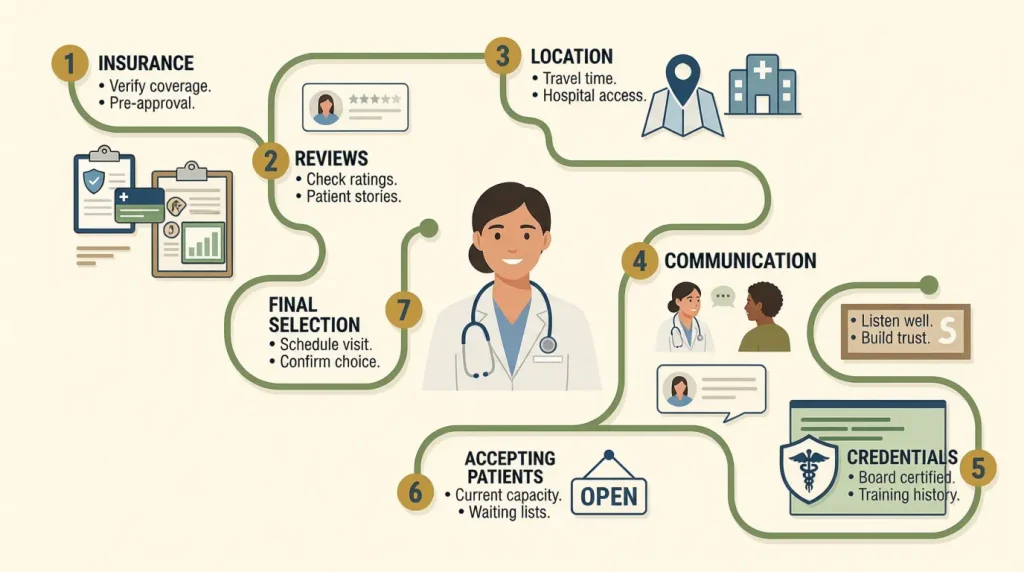
1. Determine What Type of Primary Care You Need
Start with your situation rather than a list of names. Consider your age, whether you need one office for the whole family, existing health concerns, upcoming preventive needs and any chronic conditions requiring regular management.
If you are unsure what type of primary care doctor should I choose, start by looking at your current and future healthcare needs. A family medicine physician may be a good option for patients who want care for different age groups in one practice, while an internal medicine physician may better fit adults managing complex health conditions.
The needs of a healthy 28-year-old are going to be different than the needs of a 62-year-old with diabetes and heart disease. Family medicine suits households; internal medicine often suits adults with complex conditions.
2. Check Whether the Doctor Accepts Your Insurance
Choosing a PCP for insurance purposes requires verifying more than the clinic’s name appearing somewhere online. Confirm all of it:
- Whether the physician is an in-network provider, not just the practice
- Whether they participate in your specific plan, since carriers run many separate plans
- Your copay for office visits and preventive care
- How your deductible applies to primary care
- Whether your plan requires you to designate a PCP and get referrals
Call both your insurance company and the front desk. Provider directory listings go stale constantly and a directory error does not protect you from an out of network bill. Ask the office directly: are you contracted with this exact plan, today?
One detail catches people out repeatedly. A physician can participate in one plan from a carrier and not another, so confirming that the practice takes your health insurance network in general is not the same as confirming they take your plan. Have your member ID card in hand and read the plan name aloud when you call.
Medication benefits sit somewhere else entirely. A practice being in network for office visits tells you nothing about whether insurance covers weight loss medication or any other drug class, since that runs through your pharmacy benefit.
3. Consider Location and Accessibility
Convenience determines whether you actually go. When learning how to pick a primary care physician, consider whether you can realistically maintain regular visits. A doctor who is difficult to reach, has limited appointment availability, or requires a long commute may make it harder to stay consistent with preventive care. Weigh distance from home and from work, parking or transit access, office hours including any evening or weekend availability and whether telehealth visits are offered.
A brilliant physician 45 minutes away in traffic gets seen less often than a good one ten minutes from your office.
4. Review the Physician’s Credentials
Physician credentials are public information and take minutes to check. Check medical education and training, board certification in family medicine or internal medicine, current state medical license, years in practice and disciplinary history with medical conditions that are relevant to you.
Board certification is the process of the physician completing an accredited residency program and passing a series of specialty exams and maintaining requirements throughout their career. Your state medical board website allows you to see if you are licensed and certified by the certifying board.
A question that needs to be answered: MD and DO are both fully licensed doctors who have equal scope and training requirements. Osteopathic physicians complete additional training in musculoskeletal manipulation, but neither degree indicates a higher standard of care.
5. Check Appointment Availability
Before pledging, ask the following questions:
- What’s the waiting time to get an initial appointment?
- Can appointments be made for the same day if you don’t feel well?
- What is the typical wait between scheduling and being seen for a routine visit?
- Who covers when your physician is out and will you see them or someone else?
- How are messages, refill requests and lab results handled between visits?
A practice booking three months out for routine care is telling you something about how accessible it will be when you need it.
6. Evaluate Communication and Care Style
This is the step people skip and it is where choosing a primary care physician stops being a paperwork exercise. Your first visit tells you most of what you need to know. One of the best ways to find a good primary care doctor is to pay attention to how the first conversation feels. A good PCP should give you time to explain concerns, answer questions clearly, and involve you when making decisions about your care. Notice if the doctor uses language you understand, does not interrupt you when you speak, is able to answer your questions directly, involves you in their decision instead of telling you what their decision is and respects your preferences about what treatment you would like.
Personalized care is not a marketing phrase here. It means recommendations built around your life, your budget and your goals rather than a template.
If you leave feeling rushed or dismissed, that is data. One awkward visit may be a bad day, but a pattern is a reason to move on.
7. Look at the Practice’s Services
The clinic behind the physician determines how much gets handled in one place. Check for on site lab testing, preventive screenings, vaccinations, physical exams and work or school forms, chronic care management, women’s and men’s health services and telehealth.
A primary care clinic with an in house lab spares you a separate trip and usually returns results faster.
Finding a Primary Care Physician: Where Should You Start?
Learning how to find a primary care physician works best when you build a list of potential providers first, then compare them based on insurance, credentials, availability, location, and how well they fit your healthcare needs.
Ask Friends and Family for Recommendations
People you trust provide you with information that no directory does: Does the doctor listen? Does the office call back? Does the doctor come 1hr late to appointments, etc. Find out what their favorite part is, as it may be different for you.
Check Your Insurance Provider Directory
Your insurer’s online directory is the practical starting point because it filters by network status immediately. Many insurance directories also allow you to filter providers by specialty or condition, location, language, and whether they are accepting new patients. These filters can help you create a smaller list of physicians who match your personal healthcare requirements. Treat the results as a candidate list to verify, not as confirmed fact.
Insurance directories are helpful, but they should not be your only source of information. Provider listings can change, so confirming directly with the practice is an important final step before scheduling your first visit.
Search Local Primary Care Practices
Searching for the best primary care physician near me returns useful geography but no quality judgment. Use it to build your list, then check credentials and network status yourself.
Practice websites often reveal more than a listing does, including physician backgrounds, services offered and how the office handles new patients.
Ask Specialists or Other Healthcare Professionals
If you already see a specialist, a physical therapist or a pharmacist, ask who they would recommend. Clinicians know which colleagues communicate well and follow through and they are usually happy to say so.
Use Professional Physician Directories
Medical board databases and specialty society directories confirm licensure and certification. Commercial review sites add patient reviews, which are worth reading with a filter on.
Reviews skew toward extremes and most complaints concern billing, parking or wait times rather than medical judgment. Read for recurring themes across many reviews and never let a handful of ratings outweigh credentials and network status.
What Makes a High-Value Primary Care Provider?
A high value provider is not the fanciest office or the longest list of services. Value means better health results relative to what the care costs you in money and time.
Preventive Care and Early Detection
Strong primary care is based on evidence-based screening guidelines (e.g. from the United States Preventive Services Task Force) that are tailored to your age and risk level and not applied to all people as a uniform screening program.
High blood pressure, prediabetes or an early cancer diagnosis at a checkup makes a difference much more than at the time symptoms happen.
Coordinated Care
In the case of multiple specialties, there has to be someone who has the big picture. A good PCP will be able to identify the drugs each one is prescribing, will be able to detect any competing medications and will not order duplicate tests.
Appropriate Use of Testing and Treatment
More testing is not better care. Unnecessary imaging and labs generate incidental findings, additional procedures, anxiety and bills without improving health, which is the point behind initiatives like Choosing Wisely.
A high value physician orders what your situation actually calls for and can explain why.
The reverse matters too. A provider who never orders anything is not practicing conservatively, they may simply be missing things. Judgment, not volume in either direction, is what you are looking for.
Patient-Centered Communication
Care you understand is care you follow. Physicians who explain reasoning, discuss options honestly and check that you actually agree with the plan get better adherence and better results.
Accessibility and Continuity
Seeing the same clinician over time is measurably valuable. Continuity correlates with fewer emergency visits and better chronic disease control, mostly because context prevents mistakes.
Focus on Long-Term Health Outcomes
The best primary care looks past today’s complaint toward the next decade. That means addressing blood pressure at 40 rather than treating heart disease at 60 and taking sleep, stress, weight and mental health seriously as clinical issues.
Changing Your PCP and Switching Plans
Nothing obligates you to stay with a physician who is not working out.
How to Switch PCP Coverage With Your Insurance
Switching primary care options is typically easy to do. Log in to your member portal or call member services and choose the new physician from the covered list and confirm the date the change shall take effect, this is typically the first of the next month or it may happen at the time of the change.
Knowing how to switch PCP assignments matters most on HMO plans, where your designated PCP controls referrals. PPO plans typically require no designation at all.
Transferring Your Medical Records
Ask your new office for a records release form and let them request the transfer. Your records belong to you and practices are required to provide them, though some charge a reasonable fee for copies.
Do not wait until your first appointment to start this. Transfers can take a couple of weeks and arriving without records means repeating labs and rebuilding a history you already have documented somewhere.
When Changing Makes Sense
Consider how to find a new PCP if you have moved, if your insurance changed and your physician is now out of network, if you cannot get appointments when you need them, if your concerns are dismissed repeatedly or if your health needs have shifted beyond what the practice handles.
Primary Care Services We Provide at LIV MED
Patients across Arlington and the Dallas Fort Worth area often reach LIV MED after cycling through urgent care visits with no one tracking the pattern. Dr. Nadeen Soederbaum, board certified in Family Medicine and Obesity Medicine, provides continuous care rather than episodic treatment, which is the entire point of having a PCP.
In our primary care services we provide annual physicals, sick visits, preventive screenings, vaccinations and management of chronic conditions including diabetes, high blood pressure and high cholesterol
An in house lab with Quest Diagnostics support means most testing happens during your visit. Same day appointments, telemedicine, bilingual Spanish speaking staff and most major insurance plans handle the accessibility questions that determine whether people actually keep appointments. Anyone finding a PCP in the area should still verify network participation for their specific plan before scheduling.
Key Takeaways
Begin with your own health needs and your insurance, in that order, since the second one narrows the field fastest. Verify network participation with both the insurer and the practice directly, because directories are frequently out of date and the resulting bill lands on you.
Weigh location and appointment availability honestly. The measure of a good choice is whether you will realistically keep going, not whether the credentials look impressive on paper.
Check board certification, licensure and relevant experience, then judge communication during your first visit. Look at what the whole practice offers, including labs, screenings and telehealth, since those determine how much gets handled without extra trips.
If your current provider no longer fits, changing is normal and usually simple. Knowing how to choose a primary care physician who suits your life is worth the time it takes, because this is the relationship that shapes your health care for the next several years.