

How Long Is the Flu Contagious and When Can You Return to Work
Influenza is spread by most adults from about 1 day before they start to feel unwell until 5-7 days after they fall ill. The first three or four days of illness are when you are most likely to be ill and not at work, so that’s when you are most at risk.
Two groups run longer. Young children can excrete the flu virus for over a week and individuals with compromised immune systems may continue to be infectious for much longer.
The non-symmetry is important because the flu contagious period doesn’t fit perfectly with the appearance of illness. Plenty of transmission happens on the day before anyone suspects the flu at all.
A first correction is that you do not need to be this way for 24 hours before you can return to normal activities, but going without a fever for 24 hours is the standard to consider yourself no longer contagious. Those are two distinct things and it’s when offices and classrooms get confused that they become outbreaks.
What Is the Flu Incubation Period?
The flu incubation period is the time between exposure to the virus and onset of the first symptom of the flu.
How Long After Exposure Do Flu Symptoms Start?
People usually start experiencing symptoms one to four days after they are exposed to the flu, most often two days after exposure. Influenza likes to come on suddenly, so many people can tell you when they became ill.
Can You Spread Flu During the Incubation Period?
Yes and that’s why it’s hard to stop the spread of the flu. You can be contagious about 24 hours before you are feeling ill, so you may spread it to other people at work or family members and not know you are sick.
What Factors Can Affect the Timeline?
Several things shift the window:
- The amount of virus you were exposed to
- Your age, since children often develop symptoms faster
- Whether you were vaccinated this season
- Your general immune health and any chronic conditions
- Which influenza strain is circulating
What to Do After a Known Flu Exposure
They should monitor symptoms for 4 days and avoid close contact with people at high risk (such as those with chronic disease and weakened immune systems, adults > 65 years and pregnant women).
If feeling well, there is no need for isolation if exposed. It does excuse a stay away from a nursing home or a neonate and it does make it worth more of the first ache or chill than usual.
Seek medical attention immediately if symptoms occur. It’s important to begin antiviral medication as early as possible, preferably within 48 hours of symptoms and the time quickly passes.
How Long Is the Flu Contagious?
The flu usually is contagious for 7 days after it starts in most healthy adults, although the length of time may vary based on your age and immune system.
When Does Flu Contagiousness Begin?
Contagiousness begins about 1 day before symptoms occur. Influenza is highly contagious because you can spread the virus without feeling sick.
When Are You Most Contagious?
Days one through three of symptoms carry the greatest risk. Viral levels are highest in the early phase of the illness, coughing and sneezing is most severe and each cough releases respiratory droplets into the air around you.
This is when it matters most (first day or two) because household transmission is most likely to happen in the first couple of days.
The virus spreads primarily via droplets that are generated when you cough, sneeze or talk and spread to those who are within about six feet of you. Shared remotes, doorknobs and phones can be wiped down because touching a contaminated surface and then your eyes, nose or mouth is a less common way to spread it, but still possible.
When Is the Flu No Longer Contagious?
It’s not a specific time that it turns off. The knowledge that flu is not contagious after 7 days means an acceptance of a gradual finish instead of an all-or-nothing finish.
Viral shedding decreases with symptoms after day 5-7, with most healthy adults being far less infectious. Risk isn’t gone at a particular time, it is gone.
Who May Stay Contagious Longer?
Three groups need extra caution:
- Young children commonly shed virus for more than seven days and sometimes up to two weeks
- People with weakened immune systems, including those receiving chemotherapy, transplant recipients and people who have advanced HIV can stay infectious for weeks
- People with severe illness requiring hospitalization tend to shed longer than those with mild cases
The older people are, the middle category applies. Their shedding may last the same amount of time as normal and have a much higher risk of complications so families should take precautions for a slightly longer period of time than they normally would with someone under 65.
Flu Contagious Period: A Day-by-Day Timeline
The flu contagious period has a definite pattern of events: exposed, incubation, symptoms, most contagious, recovery, then less contagious.
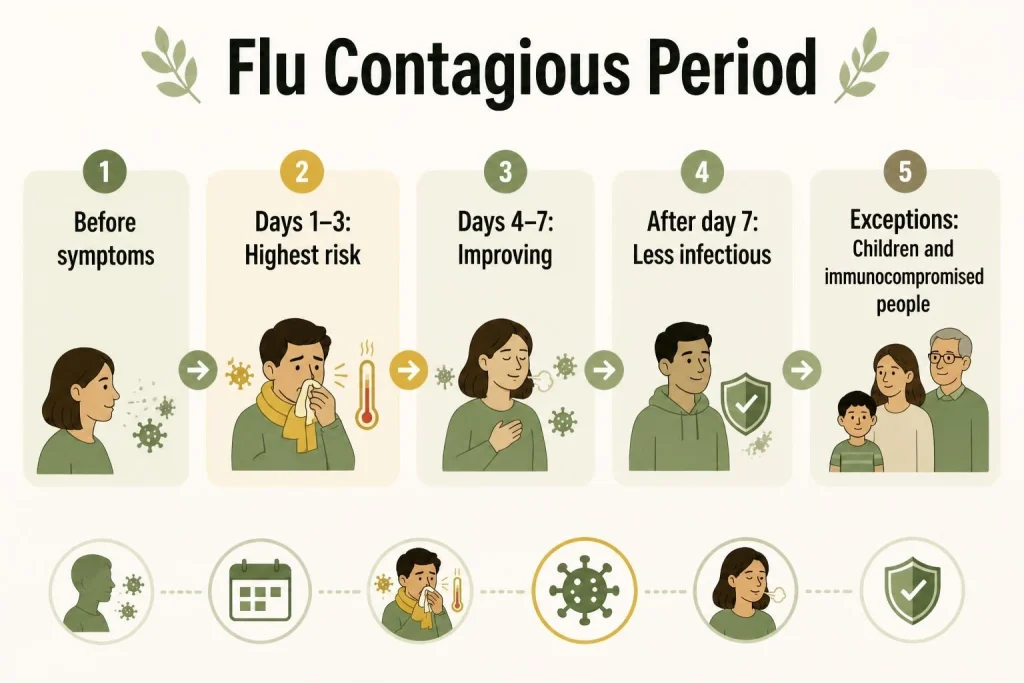
Before Symptoms Begin
During the final day of incubation you are already contagious without knowing it. Nothing feels wrong yet, so nothing changes about your behavior and this is where most flu transmission quietly happens.
Days 1 to 3 of Symptoms
Fever, aches and cough arrive, viral shedding peaks and this is the highest risk stretch of the entire illness. Stay home completely during these days if you possibly can.
This is also the period when a decision is made for treatment. It’s less important right now that you know how long the flu is contagious than that you begin antivirals if qualified, which can only be done by about the 48-hour mark.
Days 4 to 7
Symptoms typically begin to improve and infectiousness decreases as symptoms improve. By this point, most healthy adults are not as contagious but a cough is still possible to spread droplets.
To feel better is not to be done. Many people start back to work around day 4/5 and unknowingly are responsible for the next wave of cases in their office.
After the First Week
Most adults are no longer meaningfully infectious after seven days. Exceptions include children and immunocompromised patients who can continue to shed long after.
What Are the Symptoms of the Flu?
Influenza is a respiratory infection and the flu symptoms occur not so much because of what’s happening as how fast it happens.
Common Flu Symptoms
Typical symptoms include:
- Fever, often 100 degrees Fahrenheit or higher, though not everyone runs one
- Chills and sweats
- Cough, usually dry and persistent
- Sore throat
- Body aches and muscle pain, frequently severe
- Headache
- Fatigue that can linger for weeks after other symptoms resolve
Children may also have vomiting and diarrhea, which adults experience less often.
Flu Symptoms vs a Common Cold
The difference is how quickly and how severely the changes are. A cold slowly worsens over the course of a day or two and is usually accompanied by sneezing and a runny nose, but generally does not cause fever in adults.
Influenza sneaks up on you and makes you feel feverish and achy as well as unable to work. When considering which one you have, it will be obvious in hindsight.
The distinction has practical value. Antivirals help treat the flu and have no effect on a cold; only one of the two seems to warrant a few days off from school.
Can You Have the Flu Without a Fever?
Yes. Fever does not always happen and older adults in particular may not have any fever, even though they are still contagious.
Cases are missed if you just use temperature to judge contagiousness.
When Flu Symptoms May Indicate a More Serious Illness
If you have symptoms that get better and then come back, accompanied by a worsening fever and cough or if you become difficult to breathe, have chest pain or pressure, persistent dizziness, confusion, seizures, severe weakness or can’t keep fluids down, seek emergency care.
Signs in kids include rapid or labored breathing, bluish lips or face, ribs that pull in as the child breathes, no tears when crying or a fever over 104 degrees.
When Is the Flu No Longer Contagious?
There’s no way to tell when you’re no longer infectious at home, so the best course of action is to wait until you feel better.
Signs That Your Risk of Transmission Is Decreasing
Symptoms such as being fever-free for 24 hours (without using fever reducing medicine), steady improvement of symptoms, return of energy and appetite and 5 days past onset of symptoms are reasonable indicators.
None of these is a stand-alone definitive proof. When energy returns as the fever returns at night, for instance, that is an indication that the illness is not done and dusted.
The recommendations outlined in the current public health guidelines include resuming normal activities after the fever has gone away for at least one day and symptoms are getting better, plus additional precautions for another five days. Washing hands often, staying several meters away from others and wearing a mask when you can lower risk during that time.
Why Symptoms and Contagiousness Do Not Always End at the Same Time
A common question patients ask is: When does flu stop being contagious? The answer is yes, usually for several days after the fever has subsided. When your fever starts to break, it doesn’t mean that the virus has been eliminated, it means that you are winning.
Coughing may continue for weeks after the infectious period has ended, so if you are coughing, you are not necessarily contagious.
Why Some People Remain Contagious Longer
Immune status drives most of the variation. A healthy 30-year-old person will recover from influenza more quickly than a child whose immune system is still developing and much quicker than a person taking immunosuppressive medication.
Severity matters too. Flu isolation requirements are more stringent in hospitals than at home because sick people shed more and for longer.
Telemedicine Visits at LIV MED
Flu is one of the best possible reasons to avoid a waiting room. Sitting among other patients while contagious spreads the virus and dragging yourself out of bed with a fever helps nobody.
LIV MED offers telemedicine visits for patients across Arlington and the Dallas Fort Worth area, which matters most in the first 48 hours when antiviral treatment is still an option. Dr. Nadeen Soederbaum can assess symptoms, determine whether testing or antivirals make sense and send a prescription to your pharmacy without you leaving home.
In our telemedicine we provide virtual visits for flu, colds and other acute concerns, plus follow ups and prescription management
Same day appointments, an in house lab with Quest Diagnostics support, bilingual Spanish speaking staff and most major insurance plans keep care accessible when you need it quickly.
Conclusion
Influenza spreads before you know you have it, which is the single most important thing to understand about how contagious is the flu in real life. That day of symptom free shedding explains most of what happens in a household or an office.
Contagiousness peaks in the first few days and declines as you recover, but it does not stop the moment your fever breaks. Children and immunocompromised patients stay infectious longer than everyone else, sometimes considerably.
Practical flu prevention during flu recovery is not complicated: stay home while symptoms are active, cover coughs, wash hands often, keep separate towels and dishes at home and take added precautions around others for several days after you feel better. Annual vaccination remains the most effective step before the season starts. It does not guarantee you avoid influenza, but vaccinated people who do get sick tend to have milder illness, fewer complications and a shorter course.
So how long is the flu contagious in practical terms? Assume about a week from the day symptoms began for a healthy adult and longer for a child. Get evaluated if symptoms are severe, if you are in a high risk group or if you improve and then get worse again. That last pattern in particular can signal a secondary infection that needs treatment.