

Is Primary Care the Same as Family Medicine? What to Know
Primary care is a type of health care that is continuous, normal and routine care that you receive from the first health care provider you go to for most of your health concerns. Family medicine is a medical specialty, with its own medical residency and medical board certification.
Put simply, primary care is what you receive. Family medicine is what your doctor trained in.
A family medicine physician can certainly be your primary care physician and countless patients do just that. The terms are not the same because other specialties offer primary care as well.
What Is Family Medicine?
Family medicine is the specialty focused on the care of the person throughout a lifetime, not one organ system or one age group.
What Does a Family Medicine Physician Treat?
The scope is intentionally broad:
- Preventive care including physicals, screenings and vaccinations
- Acute diseases like flu and injuries
- Managing chronic diseases such as diabetes, high blood pressure, asthma and cholesterol
- Minor injuries like sprains, cuts and minor wounds.
- Consultation for women’s health issues including contraceptive counseling and routine gynecologic screening
- Male health, prostate screening and concerns regarding testosterone
- Child health services including well child checks, vaccines and childhood illnesses
- Care for older adults, such as medication review and mobility issues
What Ages Does Family Medicine Treat?
Infants to the elderly (ninetieths and higher). It is the hallmark of the specialty and what makes the family doctor so successful in caring for an entire family within a single home.
In practical terms that means that within the same afternoon, a father and child can be seen by the same doctor who is familiar with the family history. It also means that when a patient reaches 18, care isn’t started all over again. Nothing changes regarding the relationship.
Is Family Medicine a Specialty?
Family physicians complete four years of medical school, then a three year family medicine residency with rotations through internal medicine, pediatrics, obstetrics, surgery, psychiatry and geriatrics.
Physicians then take a board certification exam administered by the American Board of Family Medicine and continue to do so periodically and through ongoing education during their professional careers. A family medicine specialist is not somebody who didn’t pursue specialty training. Breadth is the specialty.
What Is Primary Care?
Primary care is not about a single problem or a single visit. It’s about returning over a number of years.
What Does a Primary Care Physician Do?
Your primary care provider is your medical home base and it’s not based on one service, but a continuity of services. They address common issues, manage long-term conditions, detect issues early with screening, coordinate anything that needs a specialist and maintain all your health information in one place!
That last part is underrated. When four different doctors prescribe four medications, someone needs to be watching the interactions and that responsibility falls to your primary care provider by default.
What Services Are Included in Primary Care?
These are common primary care services:
- Once-a-year physical exams/wellness visits
- To prevent cancer, diabetes and cardiovascular risk through health screening
- Children’s and adults’ vaccinations
- Basic treatment for common ailments like sore throats, infections and rashes
- The maintenance of chronic conditions.
- Prescribed medications and medication refills
- Referrals to specialists when a problem needs deeper expertise
Why Is Primary Care Important?
Continuity of care produces better outcomes and the research on this is consistent. Populations with strong primary care access have lower mortality, fewer hospitalizations and lower overall healthcare costs.
The mechanism is not mysterious. A provider who has seen you for six years notices when something is off, catches a rising blood pressure trend before it becomes a problem and knows which symptoms are normal for you.
Cost follows the same pattern. Conditions caught during a routine visit cost far less to treat than the same conditions caught in an emergency room and patients with a regular provider end up in the emergency room less often to begin with.
Is Primary Care the Same as Family Medicine?
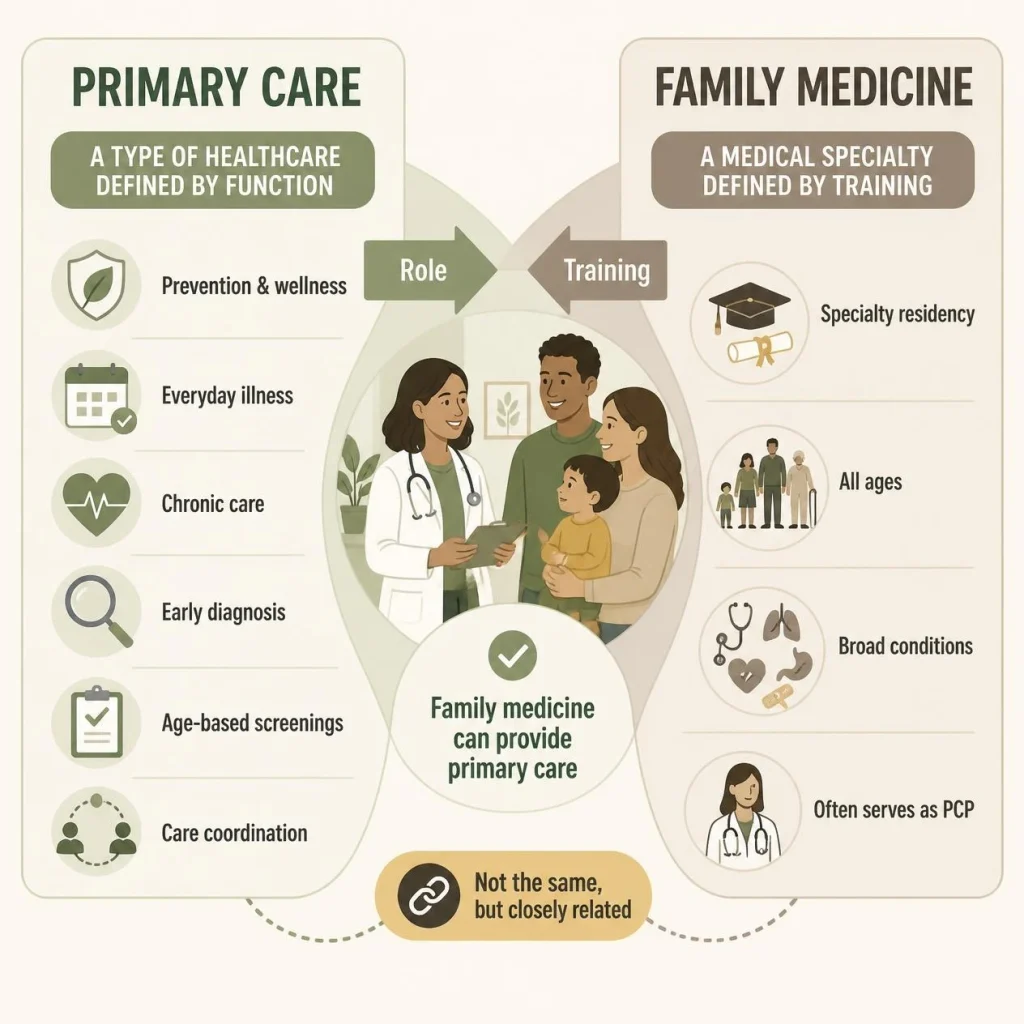
Not quite. Primary care is a category of healthcare defined by its role, while family medicine is one of several specialties that deliver it. All family physicians practice primary care, but not all primary care comes from family physicians.
Primary Care Is a Type of Healthcare
Primary care is defined by function rather than credential. It covers:
- The prevention and promotion of well-being
- Routine health concerns and everyday illness
- Chronic condition management over time
- Early diagnosis before problems escalate
- Screenings appropriate to your age and risk
- Coordination across every other provider you see
Family Medicine Is a Medical Specialty
Family medicine is defined by training. Physicians complete residency specifically designed to prepare them for the full range of ages and conditions they will encounter, which is a different curriculum from internal medicine or pediatrics.
The distinction matters when comparing family medicine vs primary care: one describes a job, the other describes a qualification.
Can a Family Medicine Doctor Be Your Primary Care Physician?
Yes and they are among the most common choices. Asking is family medicine primary care usually comes down to insurance paperwork and family physicians qualify as PCP designations on essentially every plan.
This is a great option for families who want to see children, parents and grandparents together in one practice, as it allows for documents and timetables to be streamlined. It also involves one doctor understanding how conditions flow in a family, which heightens screening choices for the whole family.
What Are the Primary Care Specialties?
Several primary care specialties exist and they differ mainly in which patients they train to treat.
Family Medicine
Covers all ages, from infants to older adults, with training spanning pediatrics, adult medicine, women’s health and geriatrics. Best suited to patients who want one provider for the whole family.
Internal Medicine
Internal medicine doctors specialize in adult primary care, typically 18 years of age and up. Patients with multiple chronic conditions may benefit from this, as their three-year residency will dive deeper into the complexity of adult disease.
Some also complete fellowships to subspecialize in cardiology, endocrinology or gastroenterology.
The practical difference between the two specialties comes down to age range and depth. Family medicine trains across every stage of life including pregnancy and childhood, while internal medicine concentrates entirely on adult disease. Both are three year residencies, both are board certified and neither is a lesser credential.
Pediatrics
A doctor specializing in childhood is a paediatrician and treats children up to age 18 or 21. Training is geared towards growth, development, schedules for childhood illnesses and immunizations.
Often parents have a pediatrician to care for their children and a separate doctor for themselves, which is fine, but two practices rather than one.
There is also a transition point worth planning for. Teenagers eventually age out of pediatric care and families using a family physician avoid that handoff entirely since the same provider continues seeing them into adulthood.
Geriatric Care
Geriatricians finish a family medicine or internal medicine residency before undertaking a fellowship to devote their time specifically to the care of older adults. They have a special interest in medication management for numerous medicines, fall risk, cognitive changes and coordination of comprehensive care for more complex patients.
Additionally, geriatricians are scarce nationally and many older adults remain with their family physician and only add a geriatrician if things get more complicated. Managing eight prescriptions, recurring falls or early cognitive changes is the point where the extra training earns its place.
Other Primary Care Providers
There are many primary care practices in which a nurse practitioner or a physician assistant works, sometimes in conjunction with a physician, depending on state law. What nurse practitioners can do is different from state to state and varies widely.
In Texas, nurse practitioners have an agreement with a supervising physician that allows them to function under a prescriptive authority agreement. Don’t assume if it’s important to you, ask the physician if they will be attending to your visits directly. Many practices have a mixture, with physicians performing more complex and advanced practice providers performing more routine visits.
Family Medicine vs Primary Care vs Urgent Care
The differences relate to whether the problem is ongoing or not and to the severity of the problem and it can save you money and time to choose the right setting.
- Family medicine or primary care: anything that requires a long-term relationship, such as follow-up visits, managing medications or any health concern in which your past is important. Yes, it is a continuous relationship and typically the cheapest option that’s available to you.
- Urgent care: acute issues that can’t be put off, but aren’t life-threatening like a sprain, suspected infection or cut requiring stitches. No current contract, moderate cost, longer opening hours.
- Emergency care: chest pain, difficulty breathing, stroke symptoms, severe bleeding, head injury or anything potentially life threatening. No ongoing relationship, highest cost, open around the clock.
When to See Your Family Medicine Doctor
For physicals, screenings, chronic condition follow-up, medication changes, new symptoms that aren’t emergencies, mental health symptoms and referrals to mental health specialists, go to your regular health care provider. Many practices will also have same-day appointments for sick visits, so please check before booking what you consider to be an urgent appointment.
When Urgent Care May Be More Appropriate
Choose urgent care when your provider’s office is closed and a telemedicine visit will not cover what you need, when you need care faster than the next available appointment or when you need imaging or stitches on the spot. Afterwards, follow up with your regular health care provider so that the visit is not a loose end, but a part of your health care record.
One practical note on cost. Urgent care typically carries a higher copay than an office visit and a far lower one than an emergency room, so the order of preference for anything non urgent is your own provider first, urgent care second and the emergency room only when symptoms could be serious.
Family Health and Primary Care Services at LIV MED
For patients across Arlington and the Dallas Fort Worth area, LIV MED offers exactly the arrangement this article describes. Dr. Nadeen Soederbaum is board certified by the American Board of Family Medicine, which means she trained specifically to provide general medicine care across ages and can serve as the primary care physician for more than one member of a household.
In our family health and medical services we provide physicals, preventive screenings, vaccinations, sick visits, chronic condition management and medication management for patients of different ages
An in house lab with Quest Diagnostics support, same day appointments, telemedicine visits, bilingual Spanish speaking staff and most major insurance plans make it practical to keep one office for most of what your family needs.
Conclusion
Asking is primary care the same as family medicine turns out to have a simpler answer than the terminology suggests. Primary care is a type of ongoing healthcare defined by its role in your life and family medicine is a board certified specialty defined by its training.
Family physicians commonly serve as primary care physicians and so do internists and pediatricians. Each covers a different age range, which is usually the deciding factor rather than any difference in quality.
It depends on such things as your age, your healthcare needs, your insurance plan, the location of the office and whether the provider gets in touch with you in a manner that suits you. It is that last factor that is often overlooked and is often most important over a relationship of years.
When you’re beginning from scratch, verify what providers are in the network first. After that, constrict based on location and appointment schedule. A well regarded physician 40 minutes away tends to lose out to a good one nearby, simply because you will actually go.