

Am I a Candidate for Weight Loss Medication? Eligibility, Options & What to Expect
The answer to “Am I a candidate for weight loss medication?” depends on more than your weight or BMI. Healthcare providers consider your BMI, medical history, current medications, previous weight loss attempts, and any health conditions related to weight before recommending prescription treatment.
Medical weight loss is not a one-size-fits-all approach. Some patients benefit from weight loss injections, while others may need lifestyle changes, nutrition support, or treatment of underlying conditions first.
At LIV MED, Dr. Nadeen Soederbaum provides physician-guided weight loss evaluations to determine whether prescription weight loss medication is appropriate based on your health, goals, and long-term needs.
Am I a Candidate for Weight Loss Medication?
Most patients asking am I a candidate for weight loss medication already suspect the answer is tied to BMI alone. It is not. BMI opens the door and everything else determines whether walking through it makes sense for you.
How Doctors Determine If You Qualify for Weight Loss Medication
A doctor does not determine eligibility based only on your weight. A complete weight loss medication evaluation looks at several factors to understand whether treatment is safe and beneficial for you.
During an evaluation, your provider may review:
- BMI and overall weight history
- Weight-related health conditions
- Previous diet and exercise efforts
- Current medications and possible interactions
- Medical history and lab results
- Lifestyle factors such as sleep, stress, and nutrition
These factors help your provider decide whether prescription weight loss medication is appropriate and which treatment option may best match your health needs.
The Basic Eligibility Factors
Providers generally weigh seven things together:
- BMI, calculated from your height and weight
- Weight-related health conditions such as high blood pressure, prediabetes, sleep apnea, fatty liver disease or high cholesterol
- Previous attempts at weight loss and what happened with each one
- Current medications, since some cause weight gain and some interact badly
- Medical history, including surgeries, thyroid disease and family history
- Lifestyle factors such as sleep, stress, work schedule and eating patterns
- Potential benefits versus risks for you specifically
These factors help determine your weight loss medication eligibility. Meeting one requirement does not automatically guarantee treatment. Your provider considers your complete health picture before recommending a medication.
Does Your BMI Qualify You?
Two thresholds appear in nearly every approved indication. The BMI standard alone is achieved for a BMI of 30 or more. BMI is considered higher if there is at least one health condition related to weight.
For many prescription weight loss treatments, a BMI of 27 or higher plus a weight-related health condition may meet the eligibility criteria.
BMI has real limits as a measurement. It does not differentiate fat from muscle and it is not the same from person to person, across ethnic groups, ages and body types. A muscular patient can be in the obesity category with no body fat and another patient can be in the “normal” category with a dangerous level of body fat.
Your provider uses BMI as a starting point and then evaluates other factors, such as your waist circumference, lab test results and blood pressure.
Can You Qualify for Weight Loss Medication With a BMI Below 30?
BMI is an important measurement when evaluating weight loss medication qualifications, but it is not the only factor.
Some adults with a BMI below 30 may still qualify if they have weight-related health conditions such as high blood pressure, high cholesterol, prediabetes, sleep apnea, or other obesity-related concerns.
Your provider will review your BMI, health risks, lab results, and treatment goals together to determine whether prescription weight loss treatment is appropriate.
Can You Qualify Without Having Diabetes?
Yes. A number of medications are specifically labeled for chronic weight management in adults who do not have diabetes and several of the major trials that led to their FDA approval included adults without diabetes.
Diabetes is not a requirement. Basically, it is one of the factors that can reduce the BMI limit from 30 to 27.
Can You Take Weight Loss Medication If You Are Only Slightly Overweight?

Usually not and the reason is the risk calculation rather than a judgment about your goals. A BMI between 25 and 27 with no health complications means medication risks are unlikely to be outweighed by medical benefit.
The exception involves patients in that range who develop a weight related condition. But all signs can be reversed in a hurry when prediabetes, obstructive sleep apnea or increasing blood pressure alter the equation, making an evaluation preferable to playing it safe with a chart.
Who May Benefit Most From Prescription Weight Loss Medication?
Eligibility and benefit are different questions. Weight loss treatments patient fit suitability depends on your health history, treatment goals, current medications and treatment response.
People With Obesity
When BMI is 30 or higher, the patient is at measurable risk for cardiovascular health, joints, liver function and metabolic stability. Medication is a tool that can be used to address appetite biology and not more willpower.
People With Overweight and Weight Related Health Conditions
Excessive weight gain is often accompanied by other medical conditions such as high blood pressure, prediabetes or sleep apnea that may improve significantly with 5-10 percent weight loss. That is achievable with the support of medical professionals, but for many patients it might be quite challenging.
People Who Have Not Achieved Adequate Results With Lifestyle Changes Alone
Weight regain after lifestyle changes is common because obesity involves complex biological factors, including appetite regulation, hormones, metabolism, and genetics.
For some patients, medication provides additional support by helping manage hunger signals while lifestyle changes continue to build long-term habits.
People Who Need Additional Support With Appetite Control
Eating plans are hard to stick to when you’re constantly hungry and thinking about food all the time. A weight loss hunger suppressant effect gives patients room to make different choices without fighting their own signals all day.
People Seeking Medically Supervised Weight Management
Medical weight loss includes lab monitoring, adjusting doses, nutrition counseling and the doctor catching issues early. That’s a structure that works for the patients who want accountability in addition to a prescription.
Who Is a Good Candidate for Weight Loss Injections?
Weight loss injections may be considered for adults who meet medical criteria and need additional support managing obesity or weight-related health risks. Good candidates often include people who:
- Have obesity or overweight with related health conditions
- Have struggled to achieve lasting results with lifestyle changes alone
- Need support with appetite regulation
- Want medically supervised weight management
Your provider will review your health history, medications, and goals before recommending options such as GLP-1 medications.
What Health Conditions May Help You Qualify for Weight Loss Medication?
Certain medical conditions can increase the potential benefits of prescription weight loss treatment. These conditions may indicate that medical weight management could support better long-term health. Examples include:
- Prediabetes or type 2 diabetes
- High blood pressure
- High cholesterol
- Sleep apnea
- Fatty liver disease
- Other obesity-related health concerns
A healthcare provider evaluates your overall health to determine whether medication may be a suitable option.
When Weight Loss Medication May Not Be Appropriate
Each drug has specific eligibility requirements and there is no universal checklist. What disqualifies you from one medication may have no bearing on another.
Certain Medical Conditions
A personal or family history of medullary thyroid carcinoma or MEN2 syndrome rules out GLP-1 based options entirely. Uncontrolled high blood pressure, heart disease, hyperthyroidism and glaucoma restrict stimulant based hunger medications.
Care should be taken in evaluating any prescription for active pancreatitis, severe gastrointestinal disease and advanced kidney disease.
Pregnancy or Plans for Pregnancy
All of these drugs are contraindicated in pregnancy and lactation and some have known teratogenicity. Usually, providers recommend stopping treatment prior to attempting to conceive.
Timing matters. Some medicines require a couple of weeks to clear and one is associated with birth defects, so it’s best to have this talk before you become pregnant.
Medication Interactions
Insulin and sulfonylureas sensitize people to low blood sugar when taken with GLP-1 drugs, so doses may have to be adjusted. Some antidepressants, anti-seizure drugs and MAO inhibitors don’t work well with certain weight loss programs.
Take a full list, including supplements. It is not uncommon for a provider to recommend one drug over the other, based on interactions.
History of Certain Conditions That Increase Medication Risks
The treatment options that remain are influenced by previous pancreatitis, gallbladder disease, seizure disorders, substance use history and significant depression. None of these automatically ends the conversation, but each changes it.
Eating Disorders and Other Factors Requiring Specialized Care
Anorexia, bulimia and binge eating disorder call for specialized treatment first. Appetite suppressing drugs can worsen restrictive patterns and some options are directly contraindicated with a bulimia or anorexia history.
Why Your Provider May Recommend Lifestyle Treatment Instead
The trend may be due to an untreated thyroid condition, weight-gaining medications or poor sleep or stress that is not managed. It is more effective to correct the root cause than apply a prescription on top of it.
What Types of Weight Loss Medications Are Available?
Different classes work through different pathways and the right match depends on your health profile as much as your goal weight.
GLP-1 and GLP-1 Based Medications
These GLP-1 medications work by mimicking an incretin (gut hormone) that is released after a meal, which slows down digestion and decreases appetite signals in the brain.
- Semaglutide: can be given weekly as an injection and, from December 2025, as a once-daily tablet to treat chronic weight management.
- Tirzepatide: a weekly injection that activates both GIP and GLP-1 receptors and produces more weight loss than semaglutide in head-to-head trials.
- Liraglutide: the oldest drug in this class and the only one used in adolescents is liraglutide, which is injected once a day.
Who Qualifies for GLP-1 Weight Loss Medication?
GLP-1 medications are generally considered for adults who meet specific medical criteria, such as having obesity or being overweight with weight-related health conditions.
Your provider will consider factors including BMI, medical history, current medications, and potential risks before recommending a GLP-1 option.
Oral Appetite Control Medications
Not everyone wants or needs an injection. Appetite control pills taken daily include stimulant based options and combination formulas and several have decades of clinical use behind them.
Oral options often cost less and suit patients with needle aversion, though average weight reduction tends to be smaller than with newer injections.
Appetite Suppressants
Phentermine is the most widely prescribed appetite suppressant in this category. It acts on the central nervous system to reduce hunger signals and is generally approved for short term use of about 12 weeks.
These medications are controlled drugs. They are not suitable for patients with heart disease, uncontrolled hypertension, hyperthyroidism or a history of substance abuse.
Combination Weight Loss Medications
Two combination products dominate this category. The two are combined with phentermine and extended-release topiramate and naltrexone and bupropion, respectively, to reduce hunger and reward-driven eating.
Combination formulas are often more effective than either ingredient or the other and have their own list of contraindications.
Other Prescription Options
Orlistat blocks absorption of a portion of dietary fat rather than touching appetite at all. Setmelanotide addresses rare genetic causes of obesity and metformin is sometimes used off label in patients with insulin resistance or PCOS.
Then there’s Topamax weight loss, which is hard to miss in search results and certainly deserves an answer. Topiramate isn’t approved to be used for weight loss alone. Its weight loss effects have been documented and this medication is only FDA-approved when combined with phentermine for weight management. Also, it poses a serious hazard during pregnancy and affects the brain, which must be monitored.
Best Shots for Weight Loss: What Are the Options?
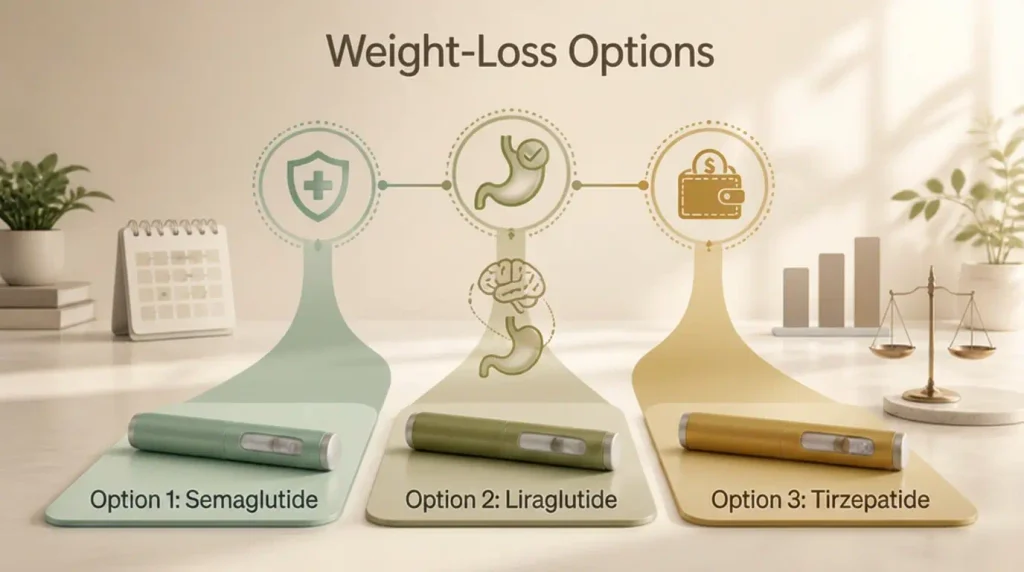
Searches for the best shots for weight loss have exploded and the honest answer is that the best injection is the one you qualify for, tolerate and can keep taking.
For patients asking who is a good candidate for weight loss injections, the same factors apply: BMI, weight-related health conditions, medical history, current medications and overall treatment risks.
How Weight Loss Injections Work
These are not fat-burning injections. They amplify a natural hormone signal which slows the emptying of the stomach, increases the sense of fullness and reduces the activity of the hunger signal areas of the brain.
Insulin secretion is also more efficient; that is, insulin is produced more in response to high blood sugar. The weight comes off because you eat less without constant effort, not because the drug dissolves fat.
GLP-1 Based Injections
Three injectable options carry weight management approvals: semaglutide and liraglutide as GLP-1 receptor agonists and tirzepatide as a dual GIP and GLP-1 agonist. Two are weekly and liraglutide is daily.
Tirzepatide vs Semaglutide
The head to head trial data favors tirzepatide on average. Over 72 weeks in adults with obesity and without diabetes, tirzepatide produced about 20 percent total body weight reduction compared with about 14 percent for semaglutide.
Averages are not promises. Semaglutide has stronger cardiovascular outcome data behind it and some patients tolerate it noticeably better.
Are Weight Loss Shots Better Than Pills?
On average, the newer injections produce larger reductions than most oral options. That advantage comes with tradeoffs worth weighing:
- Injections generally cost more and face tighter insurance restrictions.
- Weekly dosing suits some schedules better than daily pills.
- Digestive side effects are common with injections and how long they last varies, though they are often milder with certain oral drugs.
- Some patients simply will not stay consistent with a needle and a medication you skip helps nobody.
Why There Is No Single “Best” Injection for Everyone
The answer varies depending on coverage, cost, supply and other health conditions and personal tolerance. Each of the following patients may receive a different recommendation: obstructive sleep apnea, heart disease and an entirely out-of-pocket patient.
Weight Loss Medication vs Diet and Exercise
This framing creates a competition that does not exist in reality. Medication and lifestyle work on different parts of the same problem.
What Lifestyle Changes Can Accomplish
Blood pressure, blood sugar, cholesterol, energy and mood levels will improve with nutrition and activity changes, sometimes long before the scale shows any results. Many individuals lose actual weight in this way, especially at first.
Difficulty: Maintenance. Long-term studies indicate that the majority of individuals will lose a significant amount of weight in a couple of years and this is mostly due to hormonal adaptation, as opposed to a loss in motivation.
When Medication May Add Additional Support
When biology is combating, weight management medicine is aiding. An early surge in hunger or a repeated failure to progress further after a certain stage indicates a physiological barrier which can be overcome with medication.
Why Medication Works Best as Part of a Comprehensive Plan
All of these drug approvals include instructions to follow a low-calorie diet and exercise regimen. The results are from structured counseling that was provided to the trial participants, as well as their prescription.
Nutrition and Protein Intake
With less appetite, it’s easy to not eat enough protein, causing muscles to be lost at an even faster rate. Eat a protein source at every meal, including fiber and regular fluids to avoid constipation and nausea.
Physical Activity and Muscle Preservation
After treatment, preventing muscle loss on a GLP-1 takes two or three resistance training sessions per week, which protects the tissue that keeps metabolism going.
Sleep and Stress Management
Short sleep leads to higher ghrelin and lower leptin levels the following day, thus hunger the next day. Chronic stress raises cortisol and both require attention along with any prescription, since they will lead to an increased desire for high-calorie food.
Online vs In-Clinic Weight Loss Prescriptions
It’s a question that patients have had to ask online versus in-clinic and telehealth has certainly made it much easier for those who don’t have a provider nearby to access weight loss prescriptions.
How Online Weight Loss Programs Work
Most online programs use an intake questionnaire, sometimes a video visit and self reported height and weight. Medication ships directly, often through a compounding pharmacy, with follow up handled by message.
Quality varies enormously. Some sites utilize licensed clinicians and may require labs; others will approve virtually anyone who fills out a form, which is why choosing a primary care physician you can actually see matters.
How In-Clinic Weight Loss Programs Work
An in-person practice will weigh and take a look at your vital signs, order lab tests, review your complete medication list and examine you before prescribing. Progress is monitored and side effects are noted with additional visits as doses are raised.
What a Comprehensive Evaluation Can Include
During a comprehensive weight loss consultation, you will be provided with information regarding:
- Complete medical history, including family history
- Review of every current medication and supplement
- Direct weight, BMI and often waist circumference measurement
- Screening for conditions tied to weight, from blood pressure to sleep apnea symptoms
- Lab testing when appropriate, such as A1C, thyroid, liver panel and lipids
- A scheduled follow up plan for monitoring and dose adjustment
Advantages and Limitations of Each Approach
Telehealth advantages include convenience, flexibility and accessibility in rural regions. It falls short if a patient has more than one disease or if they are taking several medications and they require a physical exam and blood tests to be ordered correctly.
In-person care wins on thoroughness and continuity and on being able to bill your insurance for weight loss medication and to coordinate with your other providers. It will take longer and be harder on you as you have to drive somewhere.
Questions to Ask Before Choosing an Online Provider
Before starting any program, get clear answers to these:
- Is a licensed clinician in my state reviewing my case and can I speak with them?
- Is the medication FDA approved or is it compounded?
- Are baseline labs required or at least offered?
- What does follow up look like and how do I report side effects?
- What is the total monthly cost and does it change as my dose increases?
Obesity Treatment Services We Provide at LIV MED
Patients in Arlington and the Dallas-Fort Worth area often search for answers about weight loss medication eligibility, GLP-1 options, and whether they qualify for prescription treatment.
At LIV MED, Dr. Nadeen Soederbaum provides comprehensive weight loss evaluations, including medical history review, appropriate lab testing, medication recommendations, nutrition guidance, and ongoing monitoring.
In our obesity treatment we offer eligibility evaluation, baseline labs, prescription weight loss treatment including oral and injectable options, dose titration, nutrition guidance and monitoring at every stage
The process is easy with an in-house lab that supports Quest Diagnostics, same-day appointments, telemedicine visits, bilingual Spanish-speaking staff and most major insurance plans.
Final Thoughts on Weight Loss Medication Eligibility
If you still haven’t got a sense of if you’re a candidate for weight loss medication, the answer is that it’s a little more than a number. BMI is the starting point, but other health factors related to weight, your list of medications, your health history and your past treatment experiences all affect the decision.
Options have expanded well beyond a single category. Injectable GLP-1 based drugs, oral combination formulas and stimulant based hunger medications all work through different mechanisms and each fits a different patient profile. Topiramate deserves particular clarity here, since it affects weight but is not a general purpose weight loss drug on its own.
There are benefits to online care as well as in-person care and neither is necessarily the wrong approach. The important thing is that a licensed provider evaluates you correctly, closely follows your response and tweaks your plan accordingly as you change. That’s the evaluation that makes a hit an answer to your query’s needs.