

The Newborn Checkup Schedule for Your Baby’s First Year and Beyond
Your newborn checkup schedule starts within days of birth. The American Academy of Pediatrics (AAP) recommends well visits at 3 to 5 days old, then at 1, 2, 4, 6, 9 and 12 months. After that, visits come at 15, 18, 24 and 30 months, and then once a year.
In Texas, many babies also have a visit at about 2 weeks old. That is when the state’s second newborn screening blood test is usually done. Parents often ask, how often does a newborn go to the doctor? Most babies have seven scheduled well visits after birth by their first birthday, plus a possible 2-week visit in Texas.
What Is a Well-Child Visit?
A well-child visit is a checkup for a baby or child who is not sick. Your doctor tracks growth, checks development, looks for early health problems and gives you guidance for the months ahead.
Sick visits are different. They focus on one problem, like a fever or a rash. Newborn well visits help doctors check your baby’s overall health, feeding, sleep and development.
The AAP and Bright Futures publish a well-child visit schedule that lists recommended checkups and screenings at each age. Most family doctors and pediatricians follow this guidance.
The Newborn Checkup Schedule at a Glance
Here is the well-baby visit schedule most families can expect. Your doctor may add visits for weight checks, jaundice or other needs.
| Age | Main focus |
| 2 months | Vaccines, growth and development |
| 4 months | Vaccines, movement and safe sleep |
| 6 months | Vaccines, starting solids and first teeth |
| 12 months | Vaccines, anemia screening and lead testing as recommended |
| 15 months | Growth, language, behavior and vaccines |
| 18 months | Developmental and autism screening |
| 24 months | Autism screening, language and behavior |
| 30 months | Developmental screening and growth |
What Happens at Each Visit in the First Year
Every well visit follows a similar pattern. A nurse weighs and measures your baby, including head size. Your doctor plots those numbers on a growth chart, does a full physical exam and asks about feeding, diapers and sleep. Then you get time for questions.
Family doctors handle these checkups as part of everyday family healthcare, so the same office can often follow your baby for years.
The First Week Visit
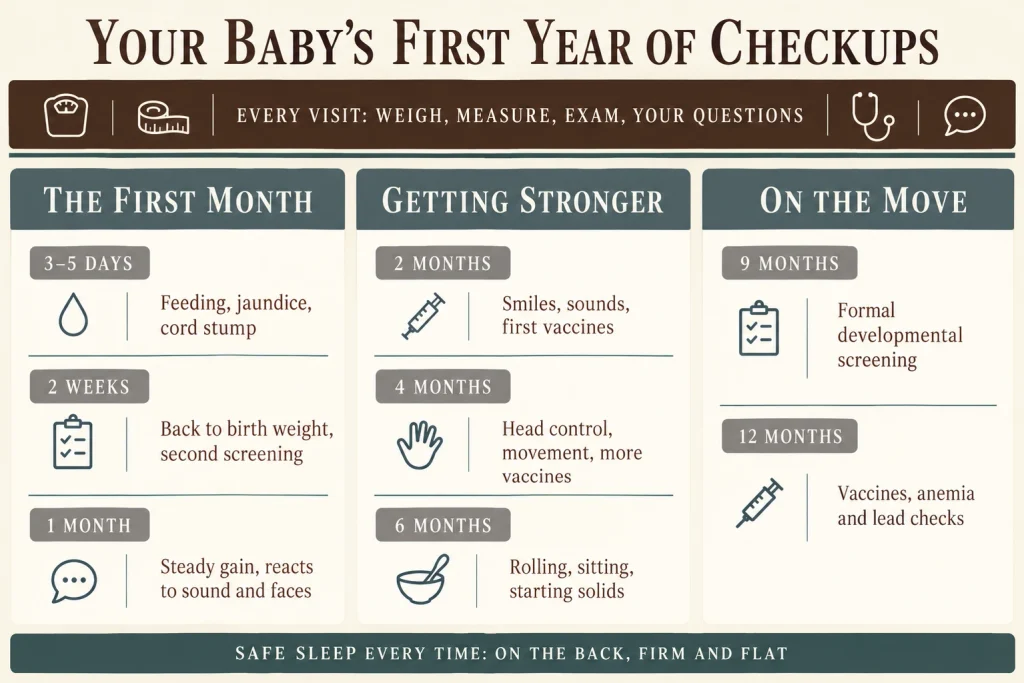
The 3 to 5 day visit happens soon after you leave the hospital. Many babies lose a little weight in the first days, so your doctor checks that feeding is going well. They also look at skin color for jaundice, check the umbilical cord stump and ask how many wet and dirty diapers your baby has each day. Your doctor may review the hospital’s newborn screening results and explain whether your baby needs another weight or feeding check.
The 2-Week Newborn Checkup
At about 2 weeks, your doctor checks your baby’s weight, feeding and diaper habits. Many babies return to their birth weight by 10 to 14 days, although some take longer.
In Texas, the second newborn screening blood test should be collected between 7 and 14 days after birth. This visit is a good time to confirm that the test has been completed.
The 1 Month Visit
By one month, your doctor wants to see steady weight gain and early signs of development, like a baby who reacts to loud sounds and looks at faces.
The doctor also asks about feeding, sleep and how your family is adjusting. Vaccine needs depend on your baby’s health history and the current schedule.
If bedtime has turned into a battle, our guide on what to do when a newborn fights sleep offers calming ideas.
The 2nd and 4th Month Visits
At 2 months, your baby may start smiling at familiar faces, making sounds and lifting their head during tummy time. Your doctor checks growth, feeding and these early skills.
The 2-month visit also includes recommended vaccines. At 4 months, your doctor checks movement, head control and how your baby responds to people and sounds. More vaccines may be due.
Both visits are important times to review safe sleep. Always place your baby on their back on a firm, flat sleep surface without loose blankets, pillows or toys.
The 6-Month Visit
At 6 months, your doctor checks growth, movement and how your baby uses their hands to explore objects. Your baby may begin rolling and sitting with support.
This visit often includes vaccines and advice about starting solid foods. The doctor may also discuss first teeth, fluoride and keeping your home safe as your baby becomes more active.
The 9 and 12 Month Visits
At 9 months, the AAP recommends a formal developmental screening. Your doctor may ask you to complete a short form about sitting, making sounds and how your baby plays. Finding delays early can help children get support when they need it.
The 12-month visit brings another round of recommended vaccines. Your doctor may also check for anemia and lead exposure based on screening guidance and your baby’s needs.
Feeding also changes around this age. Your doctor can help you plan healthy meals, drinks and new eating habits.
Well-Child Visits After the First Birthday
Well-child visits continue as your baby grows into a toddler. At 15 months, the doctor checks growth, speech, movement and behavior.
At 18 months, children should have developmental and autism screening. Another autism screening is recommended at 24 months, while a general developmental screening is recommended at 30 months.
These checkups help doctors spot delays in speech, learning or social skills. The AAP’s developmental screening guidance explains why these checks matter. After age 3, most children have one well-child checkup each year.
Why Texas Babies Get a Second Heel Stick
Texas is a two-screen state. State rules require newborn screening blood samples to be collected at 24 to 48 hours of age and again at 7 to 14 days.
According to the Texas Department of State Health Services, some disorders only show up on the second test because a baby’s body changes quickly after birth.
A normal first screen does not replace the second one.
If your baby was born at home or with a midwife, or you are not sure the second screen was done, contact your baby’s doctor. If the test was missed, it should still be collected as soon as possible.
Myths That Throw Off an Infant Well Check Schedule
These common beliefs lead families to skip or delay visits.
1. My baby seems healthy, so we can skip it
Many problems, like hip issues, heart murmurs or slow weight gain, have no obvious signs at home. Well visits exist to catch what you cannot see.
2. Only a Pediatrician Can See a Newborn
Family doctors are also trained to care for newborns and children. Both family physicians and pediatricians can follow recommended well-child visit guidance.
Having one doctor for the whole family can also make visits easier to plan. Our article on how to choose a primary care physician explains what to look for.
3. Preemies Follow a Completely Different Calendar
Premature babies often follow the usual well-child visit schedule, but they may need extra checkups for growth, feeding and development.
Most routine vaccines are given based on the baby’s age from birth, although some situations need special care. Doctors may use corrected age to check developmental progress.
Always follow the plan given by your baby’s healthcare team.
4. A Late Visit Does Not Matter
Well-child appointments have some flexibility, but certain tests and vaccines have important time limits.
If you miss a visit, call your baby’s doctor to arrange another appointment. Do not wait until the next routine checkup without asking.
Visits Are for Parents Too
Newborn checkups are not only about the baby. The AAP recommends screening mothers for postpartum depression at the 1, 2, 4 and 6 month visits. You may be asked a few short questions about mood, sleep and support at home.
Answer honestly. Baby blues often fade within two weeks, but sadness, worry or numbness that lasts longer may need care. Partners can struggle too.
If these feelings affect your daily life, ask your doctor about mental health support.
Tips to Keep Your Baby Appointment Schedule on Track
- Book the next well visit before leaving each appointment.
- Keep a list of questions on your phone between visits.
- Bring hospital discharge papers and vaccine records to the first visit.
- Ask which screenings or vaccines your baby needs next.
- Check your insurance coverage. Many plans cover recommended well-child visits as preventive care.
When to Call Between Scheduled Visits
If something feels wrong, do not wait for the next well visit.
Call your baby’s doctor immediately if your baby is younger than 3 months and has a temperature of 100.4°F (38°C) or higher. A young baby with a fever needs prompt medical evaluation, even if they seem well.
Also contact your doctor promptly if your baby:
- Feeds poorly or has fewer wet diapers than usual.
- Has yellow skin or eyes that seem to be getting worse.
- Cries for hours and cannot be soothed.
- Shows unusual changes in feeding, movement or behavior.
If your baby has trouble breathing, blue lips, is floppy or cannot be awakened, call 911.
For other health concerns between checkups, a sick visit may help your doctor find the problem without waiting for the next well visit.
How LIV MED Supports Families Through Every Newborn Checkup
A newborn checkup schedule can feel like a lot of appointments at a time when you are short on sleep. Each visit is a chance to confirm your baby is growing well, catch problems early and get real answers to your questions.
At LIV MED in Arlington, Dr. Nadeen Soederbaum is board certified by the American Board of Family Medicine. We care for every member of the family, from newborns to grandparents, so your baby’s well visits and your own care can happen in one place.
Our bilingual staff speaks Spanish, and our in-house lab supports testing when needed. To plan your baby’s next visit, call (682) 220-9646 or request an appointment.